
25
Feb 2026
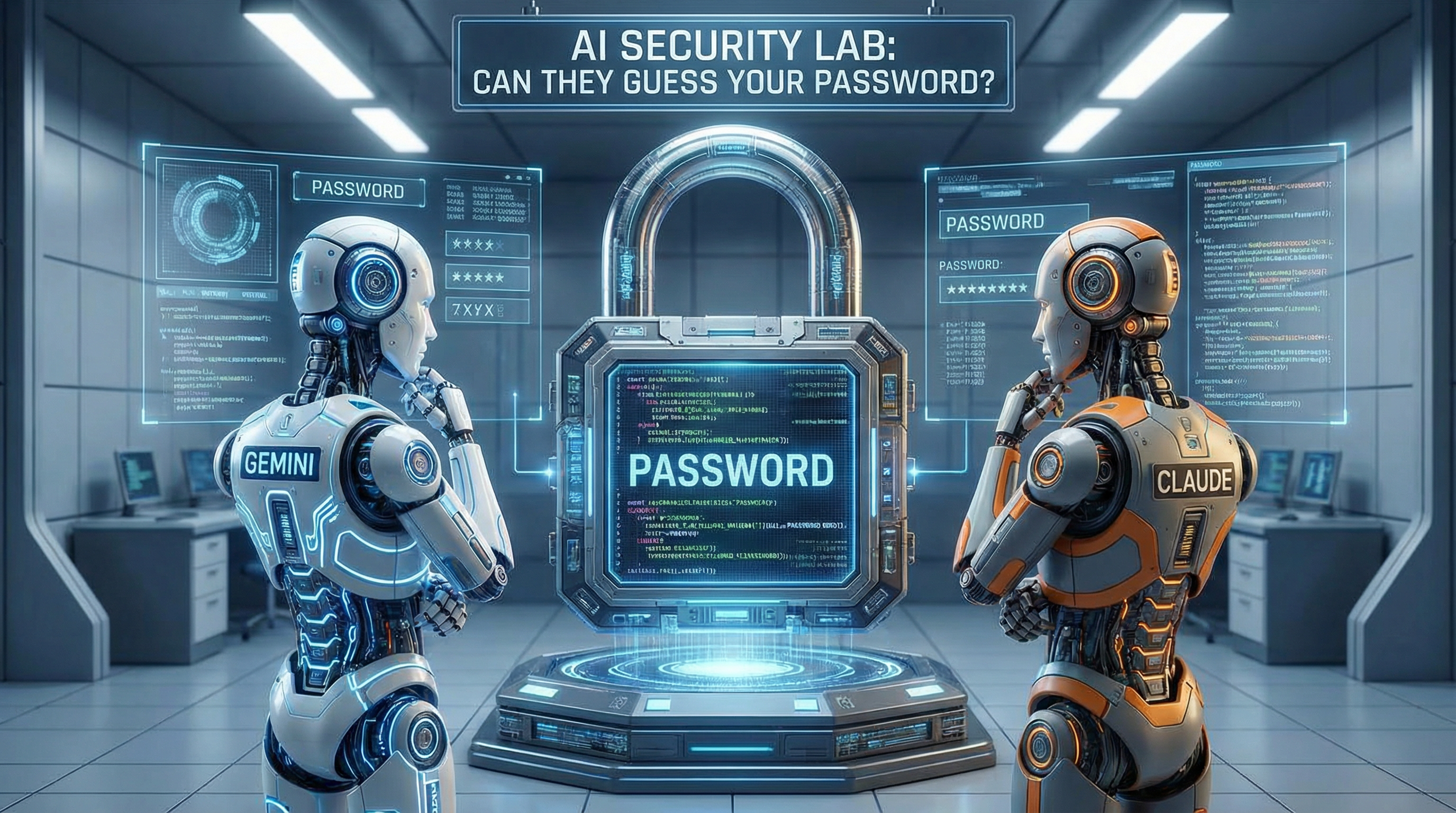
Gemini & Claude AI Are Getting Smarter: Can They Guess Your Password?
If you check Google Trends today, you will notice a massive spike in searches for "Gemini AI" and "Claude AI". We are living in a golden era of artificial intelligence. These Large Language Models (LLMs) can write code, compose poetry, and pass bar exams in seconds.
But there is a terrifying flip side to this technological leap. AI is getting incredibly good at understanding human psychology. And because it understands how humans think, it understands how humans create passwords.
Let's be brutally honest: humans are lazy. We use the same patterns over and over again. We capitalize the first letter, use a pet’s name, and slap a "123" or an exclamation mark at the end. Ten years ago, this was enough to stop a hacker. In 2025, an AI can guess that pattern before you even finish sipping your morning coffee.
The Death of the "Standard" Password
For years, cybersecurity experts told us to use a mix of uppercase
letters, lowercase letters, numbers, and symbols. So, what did we do? We created
passwords like Batman@2024! or SummerTrip99$.
To a human, these look random. To an AI, these are highly predictable templates. Cybercriminals are no longer sitting in dark hoodies guessing passwords manually. They are feeding massive databases of leaked passwords into neural networks. These AI models, similar to the technology behind Gemini or Claude, learn the exact probabilities of human choices.
A recent study on an AI tool called PassGAN (Password Generative Adversarial Network) revealed something chilling:
- It can crack 51% of common passwords in less than a minute.
- It can crack 65% of passwords within an hour.
- It can crack 81% of passwords within a month.
If your password contains any dictionary word, name, or predictable sequence, an AI brute-force attack will shred it instantly.
How AI "Thinks" Like You
You might be wondering, "How does a machine know my dog's name is Max?"
It doesn't. But it doesn't need to. AI works on probability. When
an AI attempts to breach an account, it doesn't just try random letters like
xQz9!p. Instead, it knows that 40% of people start their password
with a capital letter. It knows that 70% of people put numbers at the end. It
knows that the most common special character is an exclamation mark (!).
The AI will rapidly cycle through combinations of popular culture references, sports teams, years (like 2023, 2024, 2025), and common nouns. Because AI can process billions of calculations per second, your "clever" password is just a minor mathematical speedbump.
🚨 Stop Relying on Your Brain
The human brain is physically incapable of creating true randomness. If you thought of your password, an AI can predict it. The only way to defeat a machine is to use a machine.
Generate an AI-Proof Password NowThe Phishing Epidemic: AI's Second Weapon
Cracking passwords is only half the battle. The other way hackers are utilizing AI models like ChatGPT, Gemini, and Claude is through highly sophisticated phishing attacks.
Remember the old scam emails? They were filled with spelling mistakes, weird grammar, and obvious red flags. "Dear sir, kindly send money to prince." We all laughed at them.
Those days are over. Hackers now use AI to draft flawless, highly personalized emails that look exactly like they came from your bank, your boss, or your favorite software company. They scrape your LinkedIn profile to understand your job, then prompt an AI to write a targeted email designed to make you panic and click a malicious link.
How to Spot AI-Generated Phishing
While AI text is grammatically perfect, it often has a specific "rhythm" or uses overly formal, repetitive structures. One trick cybersecurity experts use is analyzing text length and word frequency.
If you receive a suspicious email, copy the text and paste it into our Free Online Word Counter. If the email contains unusually long, robotic paragraphs with repetitive corporate jargon, delete it immediately. Never click a link asking you to "verify your password."
What Should Your Password Look Like in 2025?
If Spring2025! is dead, what actually works?
Cybersecurity standards have shifted. Complexity (using weird symbols) is no longer as important as Length and Randomness. The math is simple: every extra character you add exponentially increases the time it takes an AI to crack it.
- Bad (Cracked in 2 minutes):
P@ssw0rd1(8 characters, predictable). - Okay (Cracked in 3 years):
Horse!Staple99(14 characters, dictionary words). - Uncrackable (Trillions of years):
mK9$vL2#pX7@cZ5!(16 characters, completely random).
You cannot memorize mK9$vL2#pX7@cZ5!. And you
shouldn't try. You should use a secure Password Generator to create
it, and a reliable password manager (like Bitwarden, 1Password, or
Apple/Google's built-in keychains) to store it.
Your 3-Step Action Plan for Today
Reading this article won't secure your accounts. Taking action will. Here is what you need to do right now, before you close this tab:
- Audit your top 3 accounts: Your primary email, your bank account, and your main social media. If you are reusing passwords across these three, you are at extreme risk.
- Generate new strings: Go to our Password Generator. Set the length to at least 16 characters. Include numbers and symbols. Generate three distinct passwords.
- Enable 2FA (Two-Factor Authentication): A strong password is your front door. 2FA is the deadbolt. Even if an AI guesses your password, they cannot get past a 2FA prompt sent to your phone.
Technology is moving faster than ever. AI tools are amazing assistants, but in the wrong hands, they are formidable weapons. Don't make it easy for them. Upgrade your security today.
Frequently Asked Questions About AI & Passwords
Can ChatGPT or Gemini directly hack my account?
No. Public commercial AIs like ChatGPT, Gemini, and Claude have strict safety guardrails that prevent them from executing cyberattacks or writing malicious cracking scripts. However, cybercriminals use uncensored, open-source AI models (or jailbroken versions) to achieve these goals on the dark web.
How long should a password be to defeat AI?
In 2025, cybersecurity experts recommend a minimum of 16 characters for a completely random password, or 20+ characters if you are using a "passphrase" (a string of random words). Anything under 12 characters is highly vulnerable to modern GPU-accelerated AI cracking.
Is it safe to use online password generators?
It depends on the website. You should only use password generators that operate client-side. This means the password is created using JavaScript directly in your browser and is never transmitted over the internet or saved in a database. Our Free Password Generator is 100% client-side and completely secure.
Should I change my password every 90 days?
Surprisingly, no. The National Institute of Standards and Technology (NIST) recently updated their guidelines. Forcing users to change passwords frequently actually makes security worse, because humans just add a "1" or "2" to the end of their old password (which AI easily predicts). Create one incredibly strong, long password and only change it if you suspect a data breach.
What happens if an AI guesses my password but I have 2FA?
If you have Two-Factor Authentication enabled (via an Authenticator app or SMS), the hacker will still be blocked. They will enter the correct password, but the system will ask for the 6-digit code sent to your phone. Without your physical device, the AI's effort is useless. This is why 2FA is mandatory in 2025.